
Your kid is building a business. What they are really building is themselves.
The business is the laboratory. What your child develops inside it is the set of capabilities you want them to carry into adulthood. A real customer, a real price and a real profit demand it. A curriculum cannot.
What Kids Business School develops.
- Agency
- Responsibility
- Resilience
- Grit
- Confidence
- Self-reliance
- Independence
- Resourcefulness
- Problem solving
- Communication
- Leadership
- Financial judgment
- Value creation
Six separate programs, or one business.
You could sign your child up for public speaking, financial literacy, leadership, sales, debate and communication. That is six schedules, six tuitions and six rooms where the stakes are hypothetical. Or they can run a business, where all of it is required at once and the feedback comes from customers.
They do not learn resilience because we lecture about grit. A customer says no, something does not sell, an idea fails, and they have to decide what to do next.
You are the buyer. Your child is the operator.
Kids Business School asks something specific of parents: get your child to the market, ask about the numbers, and let them handle the money and the rejection themselves. It is not enrichment, not a camp, and not a project you help produce.
Who this is for
- Wants their child in an ongoing discipline, not a one-off project
- Is comfortable with real rejection and real failure as part of learning
- Will get the student to the market and let the student run the table
- Is looking for years of development, not a single certificate
Who this is not for
- Wants a cute one-off craft project to display
- Is looking for a drop-off babysitting hour
- Wants to direct the business and have the child execute it
- Wants guaranteed success with no risk of a bad day
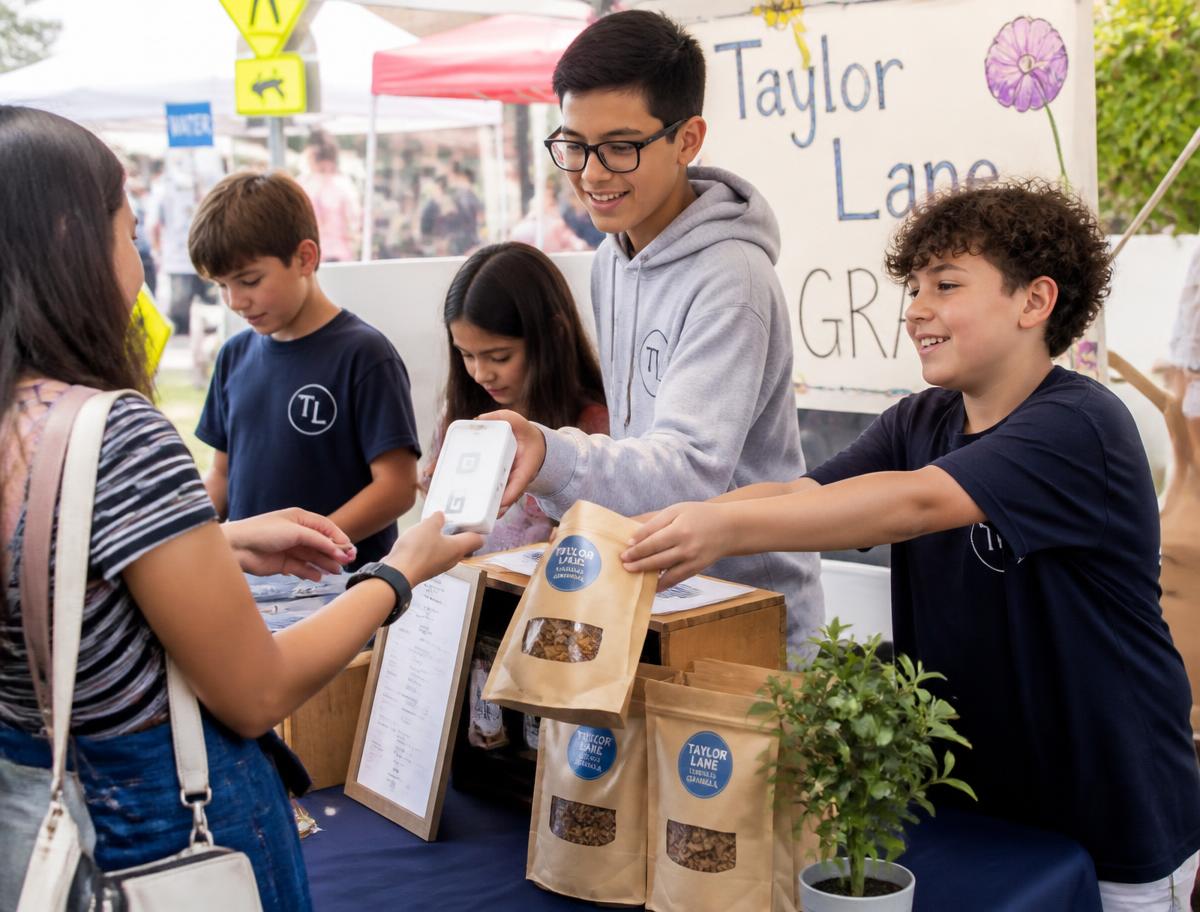
Support the operation. Do not run it.
The rejection, the miscount, the slow market day are the curriculum. A parent who steps in to make the sale or fix the mistake removes the exact experience the student is there to get.
Do
- Get them to the market
- Ask what the numbers said
- Let them handle the money
- Let them hear 'no'
Do not
- Make the sale for them
- Complete the work for them
- Prevent every failure
- Turn it into a parent-directed project
One field trip does not build a skill.
Exposure, a single project, a single pitch, a single lesson on money, gives a child a memory. It does not give them a skill. Skills come from repeated, coached practice under real conditions, over months and years. That is true of every other discipline parents already invest in.
Martial arts
Nobody expects a black belt after one class. Competence is built through repeated practice against real resistance.
Music
A student does not become a musician from a single recital. They improve through weekly practice and performance.
Competitive sport
Skill comes from practice, game reps and coaching feedback over a season, not a single scrimmage.
Most youth business programs stop at exposure.
Simulation programs
Fake money, fake customers, fake stakes. Students learn to play a game, not to run a business.
Six-week courses
They end right when the first sale happens, the point where real learning is just beginning.
Shark Tank style pitch events
A fictional pitch to judges at an expensive private school rewards performance, not operating results.
Evidence, visible over time.
Parents should expect to see evidence, not just enthusiasm: revenue, customers, decisions and recovery from rejection, all visible in the student platform as it builds session over session. Progress is a record, not a feeling.
Safety and supervision
- Public selling is always supervised by an adult.
- Students never meet unknown adults alone.
- All online activity is supervised.
- Personal information stays private.
- The school provides educational coaching only, not legal, tax or financial advice.
Enrollment is open at our Miami, Fort Lauderdale and Boca Raton locations.
Classes are capped at 20 to 25 students. Apply to enroll, or review tuition and how a session runs first.