
Kids build and operate real businesses.
First business in 12 weeks. Then years of getting better at business.
Students find real customers, make real sales, and track real numbers, building the judgment, agency and communication skills they will need as adults.
- Ages
- 8 to 14
- Classes
- 2/week
- First business
- 12 weeks

First class free. Parents sit in.
Bring your child to a full 60-minute session at no cost. They will not watch. They will work. Most students leave their first class holding a one-page business plan they built with an instructor: the customer, the offer, the price, the pitch, and a first-day revenue goal. Parents stay in the room for the whole session. No payment, no commitment, no card required.
- Length
- 60 minutes
- Cost
- $0, no credit card
- Parents
- Welcome in the room
A real business, launched. Not a project turned in.
Every new student starts on the Business Launch Path: an assessment, a customer, an offer, a price, first sales, and a P&L they can explain out loud. Twelve weeks in, they are operating something real.
Assessment and idea
Business assessment, a customer worth serving, and a one-page plan built with an instructor.
First offer
Price it, build the pitch, run customer interviews, and make the first real sales attempts.
First customers, first $100
Sell in the market, log every transaction, and work toward the First $100 Challenge.
Repeat, measure, advance
Repeat customers and referrals, a P&L the student can explain out loud, and the first belt evaluation.
Then the school begins
12 weeks gives them an immediate, concrete mission.
The business gives every lesson its real-world context.
Results convince the parents because revenue is proof they can see.
Belts give the student progression worth staying for.
Peers create belonging and make action normal.
Harder businesses keep challenging them year after year.
Your kid is building a business. In the process they are building themselves.
The business is the laboratory. These are the skills it develops, not because we lecture about them, but because running a real business requires them every week.
- Agency
- Responsibility
- Resilience
- Grit
- Confidence
- Self-reliance
- Independence
- Resourcefulness
- Problem solving
- Communication
- Leadership
- Financial judgment
- Value creation
One program. A lot fewer classes.
You could enroll your child in public speaking, financial literacy, leadership, sales, debate and communication separately. Or they can build a business, where all of it is required at once. They do not learn to pitch because Tuesday is pitching day. They learn it because a customer is standing in front of them.
Entrepreneurship is a discipline, not an activity.
Most youth business programs teach vocabulary, run a short simulation, or help a child produce one project and a photograph. That is exposure. Exposure does not make an entrepreneur. Repetition does.
What this is not
- A financial literacy class
- A business themed summer camp
- A hypothetical startup competition
- A separate enrichment class for each of these skills
- A six week course that ends after the first sale
- A parent directed school project
What this is
- A twice weekly in person operating environment
- Real customers and real revenue
- Numbers reviewed out loud, every session
- Peer accountability across mixed ages
- Coaching from instructors who have built businesses
- A progression that can run for years
Learn → Build → Sell → Measure → Improve → Advance
The loop repeats every session for as long as the student is enrolled. Each pass through it produces evidence: a number, a customer, a decision, a next action.
Learn
One practical business principle per session. Pricing, margin, offers, follow-up.
Build
Choose a customer, create an offer, set a price, prepare to sell.
Sell
Real sales attempts to real customers. Markets, doors, events, online.
Measure
Revenue, cost, hours, customers. Margin per unit. Profit, not activity.
Improve
Review what worked and what failed, then change the offer or the process.
Advance
Move up by demonstrating competence, not by attendance or worksheets.
The peer environment does the heavy lifting.
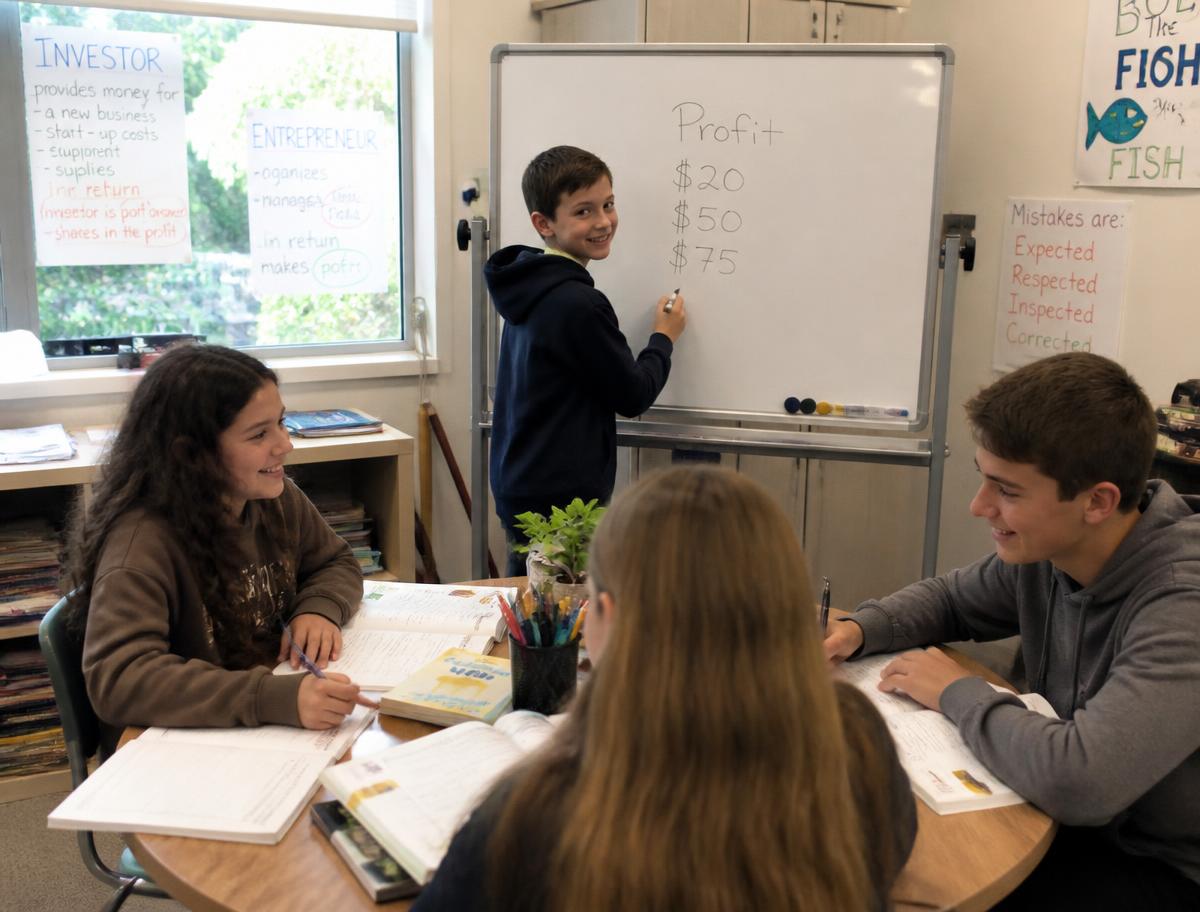
A student who hears another student explain how they sold out a table of soap and cleared $100 stops asking whether it is possible. Classes are deliberately mixed age. Eight-year-olds sit beside 14-year-olds, and advanced students mentor newer ones. That removes excuses and makes action normal.
Every student reports out loud: what they sold, what it cost, what they earned, what they will change before the next session.
“We sold 50 soaps and made over $100. The whole table was finished.”

Built by a founder who has been raising this way for years.
Jay Bourgana has spent his career building and turning around companies. For the last several years he has built communities for entrepreneurs and for fathers. He founded Raising Lions, a community for fathers focused on raising strong, resilient kids, and Acquisition Collective, a network for entrepreneurs acquiring and scaling businesses. Kids Business School came from a simple observation. The capabilities that make someone effective as an adult, agency, resilience, the nerve to ask for the sale, are not taught in a classroom. They are built by doing the thing, repeatedly, with coaching.
“I wanted my own kids to learn how money and customers actually work, so I built the school I wished existed.”
Enrollment is open at our Miami, Fort Lauderdale and Boca Raton locations.
Start with a free 60-minute class. In person in Miami, Fort Lauderdale or Boca Raton, or Live Online from anywhere. No credit card required.